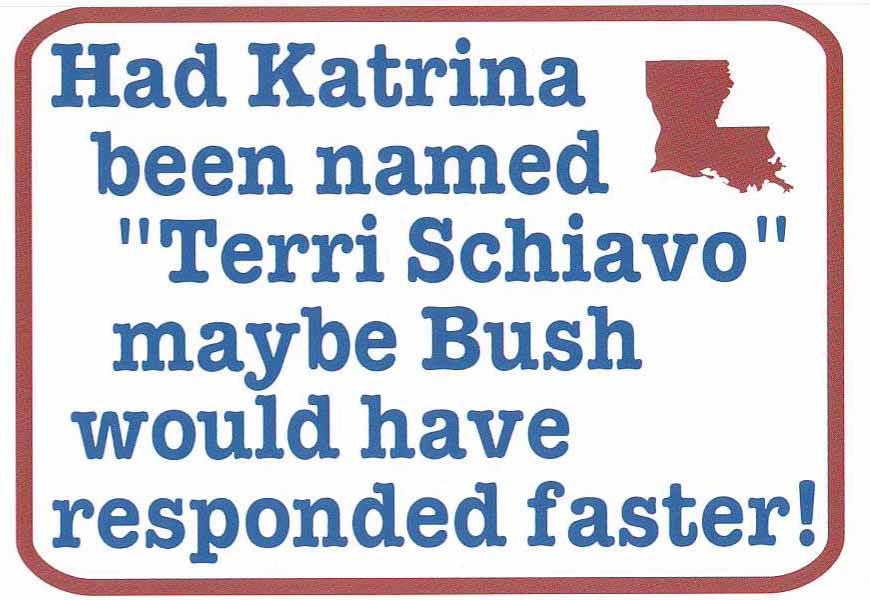
I've written it before and I'll write it again - I dislike copy/pasting stuff to the blog, but this one must be read to be believed. After spending the last 6+ years dividing and conquering the electorate, suddenly President Bush is changing his tune, now that he doesn't have a rubber-stamp Congress at his beckon call.
All of a sudden, Bush is calling for bipartisanship and cooperation from a Democratically controlled Congress. I wonder if he'll get it, but more importantly, I don't really feel he deserves it. The president and his party have willfully ignored almost every Democrat in Congress during his entire administration, and now he offers a phony olive branch, so if Democrats begin to give the president and the minority party a difficult time, Republicans will paint the Democrats as the partisan party.
Phooey. I ain't buyin' it, and neither should Democrats or the American public. Of course, there will always be a certain amount of the populace who will buy whatever Bill O'Lielly or Rush Limbaugh tells them. Not much can be done about that, but this is classic Bush. Quick example, and I've written about it often.
Following 9-11, the president was steadfastly against the creation of the Department of Homeland Security. The Democrats and a few Republicans were on the other side of the debate, favoring a massive reorganization of the federal government to enable it to more effectively fight terrorism. When public opinion also came down on the side of creating the DHS, Bush (Read: Rove) abruptly not only favored a DHS, but Republicans structured the bill in such a way that there was no way that most Democrats would vote for it. How did they do that? By trying to take away the collective bargaining rights of the over 300,000 federal employees. Bush glibly claimed he "needed flexibility" when setting up the new department.
The result? Many Democrats voted "No" on the initial bill, and right away, they were "siding with the terrorists." And of course, anti-union Republicans ate this whole thing up like a sizzling South Philadelphia cheese steak. It was those "damn unions" again. Of course, that's not what's really happened, but few people I knew at the time cared to get beyond the political rhetoric.
It's just one in a long list of examples of Bush and Rasputin Rove changing tactics and trying to take the credit, just as they are now. The minute Democrats disagree with the president or try to to deny him his agenda, they will be painted as "obstructionists," a cry we heard from a desperate party a lot prior to the 2006 mid-term election. It ain't obstructionism, folks, it's accountability and oversight -- and this president has had precious little both.
Anyway, on to the president's editorial, which appeared in the Wall Street Journal this past Wednesday. Two quick thoughts, and then on to the piece.

First, the piece appeared with a graphic of a hand similar to the one on the left of a hand reaching down, as if toward reconciliation. Umm Hmm.

The piece should have appeared with the picture at right.
Bush running for president in 2000 with the campaign slogan "I'm a uniter, not a divider" is a lie that will take its place in presidential history alongside these:
"I did not have sexual relations with that woman, Ms. Lewinsky"
"Read--My--Lips...No--New--Taxes!"
"People need to know whether or not their president is a cook. Well, I'm not a crook."
Second, it's pretty fitting that Bush's piece appears on the Wall Street Journal's blood-soaked editorial page. The WSJ's witch hunt against people in the Clinton administration, most notably Vince Foster, is well documented. It's also well known that the stories the WSJ printed about Foster sent him into a deeper depression, and it's not a stretch to say those pieces played a part in his suicide.
Anyway, here's the president's totally sincere piece. Read, enjoy, laugh, repeat.
What the Congress Can Do for America
Let them say of these next two years: We used our time well
BY GEORGE W. BUSH
Tomorrow, members of the 110th Congress will take their oaths of office here in Washington. I will have the privilege of working with them for the next two years--one quarter of my presidency, plenty of time to accomplish important things for the American people.
Together, we have a chance to serve the American people by solving the complex problems that many don't expect us to tackle, let alone solve, in the partisan environment of today's Washington. To do that, however, we can't play politics as usual. Democrats will control the House and Senate, and therefore we share the responsibility for what we achieve.
In the days and weeks since the November elections, I have been encouraged by the productive meetings I've had with many of the new leaders in Congress from both parties. I am hopeful we can find common ground without compromising our principles.
I believe we share many of the same goals for the people we serve--and with good will and hard effort, we can find practical ways to advance the American Dream and keep our nation safe.
My principles are no secret. I have campaigned on them in my races for governor and in two presidential contests, and I have worked hard during my presidency to translate these principles into sound policy.
I believe that when America is willing to use her influence abroad, the American people are safer and the world is more secure. I believe that wealth does not come from government. It comes from the hard work of America's workers, entrepreneurs and small businesses. I believe government closest to the people is more responsive and accountable. I believe government plays an important role in helping those who can't help themselves. Yet we must always remember that when people are hurting, they need a caring person, not a government bureaucracy.
These are all common-sense principles, and they provide the basis for how I will approach governing with the new Congress. We've proved it can be done: When our nation was attacked, Republicans and Democrats came together to pass the Patriot Act and reform our intelligence agencies. When our economy was struggling, we worked together to pass tax relief that has helped our economy grow, create jobs, and raise the standard of living for the American people. When we saw that our public schools were failing our children, we came together to pass the No Child Left Behind Act, insisting on high standards, accountability and better options for parents.
The outcome of the elections has changed the balance of power in Congress, yet the priorities for keeping our country safe and prosperous go beyond party labels.
Our priorities begin with defeating the terrorists who killed thousands of innocent Americans on September 11, 2001--and who are working hard to attack us again. These terrorists are part of a broader extremist movement that is now doing everything it can to defeat us in Iraq. In the days ahead, I will be addressing our nation about a new strategy to help the Iraqi people gain control of the security situation and hasten the day when the Iraqi government gains full control over its affairs. Ultimately, Iraqis must resolve the most pressing issues facing them. We can't do it for them.
But we can help Iraq defeat the extremists inside and outside of Iraq--and we can help provide the necessary breathing space for this young government to meet its responsibilities. If democracy fails and the extremists prevail in Iraq, America's enemies will be stronger, more lethal, and emboldened by our defeat. Leaders in both parties understand the stakes in this struggle. We now have the opportunity to build a bipartisan consensus to fight and win the war.
America's priorities also include keeping our economy strong. The elections have not reversed the laws of economics. It is a fact that economies do best when you reward hard work by allowing people to keep more of what they have earned. And we have seen that businesses can expand and hire more workers when they have more money to invest--and since August 2003, America's employers have added more than seven million new jobs.
It is also a fact that our tax cuts have fueled robust economic growth and record revenues. Because revenues have grown and we've done a better job of holding the line on domestic spending, we met our goal of cutting the deficit in half three years ahead of schedule. By continuing these policies, we can balance the federal budget by 2012 while funding our priorities and making the tax cuts permanent. In early February, I will submit a budget that does exactly that. The bottom line is tax relief and spending restraint are good for the American worker, good for the American taxpayer, and good for the federal budget. Now is not the time to raise taxes on the American people.
By balancing the budget through pro-growth economic policies and spending restraint, we are better positioned to tackle the longer term fiscal challenge facing our country: reforming entitlements--Social Security, Medicare and Medicaid--so future generations can benefit from these vital programs without bankrupting our country.
One important message I took away from the election is that people want to end the secretive process by which Washington insiders are able to slip into legislation billions of dollars of pork-barrel projects that have never been reviewed or voted on by Congress. I'm glad Senator Robert Byrd and Congressman Dave Obey--the Democrats who will lead the appropriations process in the new Congress--heard that message, too, and have indicated they will refrain from including additional earmarks in the continuing resolution for this fiscal year.
But we can and should do more. It's time Congress give the president a line-item veto. And today I will announce my own proposal to end this dead-of-the-night process and substantially cut the earmarks passed each year.
The strength of our economy also requires us to address some of the biggest issues facing the American people--greater energy security, comprehensive immigration reform, and affordable health care. While progress has been made in each of these areas, we must do more. I look forward to working with Congress on these difficult issues.
Our Founders believed in the wisdom of the American people to choose their leaders and provided for the concept of divided and effective government. The majority party in Congress gets to pass the bills it wants. The minority party, especially where the margins are close, has a strong say in the form bills take. And the Constitution leaves it to the president to use his judgment whether they should be signed into law.
That gives us a clear challenge and an opportunity. If the Congress chooses to pass bills that are simply political statements, they will have chosen stalemate. If a different approach is taken, the next two years can be fruitful ones for our nation. We can show the American people that Republicans and Democrats can come together to find ways to help make America a more secure, prosperous and hopeful society. And we will show our enemies that the open debate they believe is a fatal weakness is the great strength that has allowed democracies to flourish and succeed.
To the new members of the 110th Congress, I offer my welcome--and my congratulations. The American people have entrusted us with public office at a momentous time for our nation. Let them say of these next two years: We used our time well.
Mr. Bush is the president of the United States.
####
I've said it before and I'll say it again - it should be an interesting two years until the next election.
Labels: 110th Congress, Bill O'Lielly, Congressional Oversight, Democratic Congress, Department of Homeland Security, DHS, President Bush, Rush Limbaugh, Wall Street Journal