







McClellan's book a stinging defection for W

I'll get to some excerpts in a minute, but having only read some excerpts from the book, I have to at least tentatively give McClellan some credit for having the courage to stand up and call out the Bush administration. However, my big question is, while all this was happening, why didn't he stand up then? It takes considerably less courage to stand up to a president when your ass isn't on the line. Courage in presidential administrations is so rare these days. It may happen behind the scenes somewhat, but I can't even remember the last time a high-level man or woman in an administration said, "I resign" over a decision made by a president. Gone are the days of people like Jerald terHorst, President Ford's press secretary, who immediately resigned when he learned that Ford, in a controversial move to this day, pardoned President Nixon.
Yesterday, The Politico ran some very interesting excerpts from the book. Among them:
• He says the White House press corps was too easy on the administration during the run-up to the war.Of course, the ideological buzzards are already circling McClellan's political carcass, ready to rip him to shreds. Actually, it's already started, and there are only excerpts out right now.
• Steve Hadley, then the deputy national security adviser, said about the erroneous assertion about Saddam Hussein seeking uranium, included in the State of the Union address of 2003: "Signing off on these facts is my responsibility. … And in this case, I blew it. I think the only solution is for me to resign." The offer "was rejected almost out of hand by others present," McClellan writes.
• Bush was "clearly irritated, ... steamed," when McClellan informed him that chief economic adviser Larry Lindsey had told The Wall Street Journal that a possible war in Iraq could cost from $100 billion to $200 billion: "'It's unacceptable,' Bush continued, his voice rising. 'He shouldn't be talking about that.'"
• Instead, McClellan's tone is often harsh. He writes, for example, that after Hurricane Katrina, the White House "spent most of the first week in a state of denial," and he blames Rove for suggesting the photo of the president comfortably observing the disaster during an Air Force One flyover. McClellan says he and counselor to the president Dan Bartlett had opposed the idea and thought it had been scrapped.
But he writes that he later was told that "Karl was convinced we needed to do it - and the president agreed."
"One of the worst disasters in our nation's history became one of the biggest disasters in Bush's presidency. Katrina and the botched federal response to it would largely come to define Bush's second term," he writes. "And the perception of this catastrophe was made worse by previous decisions President Bush had made, including, first and foremost, the failure to be open and forthright on Iraq and rushing to war with inadequate planning and preparation for its aftermath."
Keith Olbermann offered come commentary last night on McClellan's book, along with Air America's Rachel Maddow...
Probably my favorite part of the above clip is when Olbermann and Maddow mention what McClellan writes about propaganda and its role in selling the War in Iraq to the American people. Propaganda?!? In a time of war? Wow.
Below is Karl Rove
It's amazing how someone who was Bush's press secretary for so long is now all of a sudden an imbecile, just because he now thinks it's appropriate to speak out against all that Bush has done.
So, let's get this straight - every single word Scott McClellan wrote is a total lie, and Karl Rove is completely innocent. RIGHT! Is there anyone who honestly believes that? C'mon...
McClellan will be on NBC's Today Show tomorrow morning, so set your DVRs, or your alarm clock, because it should be a good interview. Here's hoping that Matt Lauer brings his A-game.
Actually, my favorite reaction so far is from the GOP toad and mouthpiece, Matt Drudge...
 Bitter beer face, Drudge. It kills me that Drudge keeps up the act that he's a "non-partisan" site, that he "goes where the story goes," yet that's a screen shot from his site this morning, bemoaning McClellan's book "snitching" on the Bush administration. Notice it doesn't say "Scott the Liar" - he's merely a "snitch." Draw your own conclusions.
Labels: Jerald terHorst, Karl Rove, Matt Drudge, Nixon Pardon, Ron Ziegler, Scott McClellan, What Happened: Inside the Bush White House and Washington's Culture of Deception (Book)
posted by RJ at 11:19 AM
0 comments


 Washington, D.C. appropriately mourned
 Just when I thought this was about as nonpartisan political event as one can see, I read after the funeral service that President Bush was the only person who required that the Rotunda in the Capitol be cleared so he could go in and view the casket, where videotape shows he stood for about seven seconds. All presidents have egos, but really? What an uncouth rube.
 This is one of my favorite pics from this week -- visitors passing by the presidents casket as he lies in state in the
  The Washington National Cathedral in Washington, D.C. is an impressive site to behold; it's too bad that most of the time that Americans see it is during occasions like these.
 My favorite part is how they robbed Bush of his 1,000,000,000th photo opportunity - when it was time for pictures, the Ford children were nowhere to be found. Good for them.
 My favorite moment from the memorial service was former
 His ascension to the Oval Office is without parallel. On October 10, 1973, President Nixon's first vice president,
  However, upon taking the oath of office, President Ford made the biggest of all political blunders - pardoning President Nixon. It's a debate that will probably rage for decades, if not centuries in American political discourse. Should Ford have pardoned Nixon, or should have Nixon suffered the consequences for his administration's
  But, I strongly feel that Ford pardoned Nixon too soon. Without even being formally charged, Nixon was exonerated of all charges. The American people deserved better. Yes, I realize I didn't "live" in those times, so I'm only going on what I've read. I was born in 1971, so I was alive, but at three years old, I remember nothing of those events.
 Several former leaders also gained experience in the Ford Administration. Future
  A Ford between two
  Here's one that a president got right - Gerald Ford tears up in the East Room of the White House while listening to President Clinton's remarks while receiving the
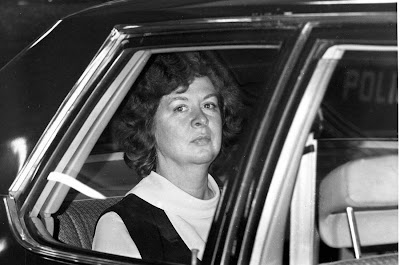
  Ford also had his dangerous detractors. On September 5, 1975,
  Fromme (above) is currently serving a life sentence.
 Just 17 days later,
  After losing the '76 election, Ford kept probably the lowest profile of any recent former president. He occasionally made an appearance or went out for a round of golf, but he didn't make headlines in the vein of Clinton or his successor, Jimmy Carter.
 He did do one thing that all other ex-presidents to date haven't managed to do, and that's live 93 years plus. He became the longest living president last month, besting Ronald Reagan by a little over a month.