










The consumer confidence crisis is growing
 It's little wonder that President Bush's approval rating is at 23 percent, which is the post-World War II low, a distinction he shares with President Truman (at the end of his second term) and President Nixon on the day he resigned the presidency. Bush's low ratings are about on par with how consumers feel about the economy right now, which is to say not very good:
Soaring gas prices and weakening job prospects left shoppers gloomier about the economy in May, sending a key barometer of consumer sentiment to its lowest level in almost 16 years.I know this phrase is trite, and it has been used over and over again in American politics, but this year, I think it's particularly apropos. What Barack Obama, the presumptive Democratic Nominee for president, should be saying over and over when referring to the Bush administration, is simply this:
The New York-based Conference Board said Tuesday that its Consumer Confidence Index dropped to 57.2, down from a revised 62.8 in April. Economists surveyed by Thomson Financial/IFR had expected a reading of 60.
The May reading marks the fifth straight month of decline and is the lowest since the index registered 54.6 in October 1992 when the economy was coming out of a recession.
Economists closely watch sentiment readings since consumer spending accounts for more than two-thirds of the nation's economic activity.
"Weakening business and job conditions coupled with growing pessimism about the short-term future have further depleted consumers' confidence in the overall state of the economy," Lynn Franco, director of the Conference Board's Consumer Research Center, said in a statement.
Are you better off now than you were eight years ago? Four years ago? If the answer is no, then you have President Bush, and one of his principle enablers, Senator McCain, to thank for that malaise.Why not? Very few, except for the extremely well off in this country (who have only gotten more well off under Bush) can probably look in the mirror and say, with a straight face, that they are doing much better now than in 2000. What's more, it worked for President Reagan in 1980 in his campaign against President Carter, so why not for Obama now?
If Obama can successfully run on the issues, and the corporate media actually reports on the issues (fat chance) - he should win this election running away.
Instead, what did we get all weekend, for example? Hillary Clinton's RFK gaffe. Our corporate media is hopelessly broken, hopelessly corporate, hopelessly infotainment and not "news," and hopelessly tied to the fortunes of the Republican Party. Our only hope in taking back our press is for Obama to become president. I'm certainly hoping he backs up his words about enforcing the Sherman Antitrust Act. He can start by dropping a huge, fat bomb smack dab in the middle of the corporate media conglomerates that dominate not only what's news, but how it's presented. We can only hope, wait and wonder, but most of all, do all we can to make sure a Democrat reaches the White House this November.
Labels: 1984 Presidential Election, Barack Obama, Consumer Confidence, Ronald Reagan, Sherman Antitrust Act, Walter Mondale
posted by RJ at 10:15 AM
0 comments


 His ascension to the Oval Office is without parallel. On October 10, 1973, President Nixon's first vice president,
  However, upon taking the oath of office, President Ford made the biggest of all political blunders - pardoning President Nixon. It's a debate that will probably rage for decades, if not centuries in American political discourse. Should Ford have pardoned Nixon, or should have Nixon suffered the consequences for his administration's
  But, I strongly feel that Ford pardoned Nixon too soon. Without even being formally charged, Nixon was exonerated of all charges. The American people deserved better. Yes, I realize I didn't "live" in those times, so I'm only going on what I've read. I was born in 1971, so I was alive, but at three years old, I remember nothing of those events.
 Several former leaders also gained experience in the Ford Administration. Future
  A Ford between two
  Here's one that a president got right - Gerald Ford tears up in the East Room of the White House while listening to President Clinton's remarks while receiving the
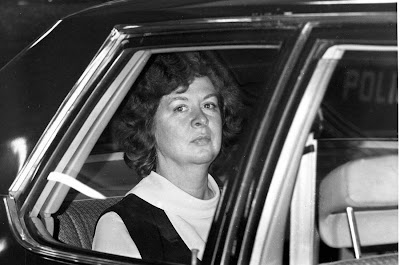
  Ford also had his dangerous detractors. On September 5, 1975,
  Fromme (above) is currently serving a life sentence.
 Just 17 days later,
  After losing the '76 election, Ford kept probably the lowest profile of any recent former president. He occasionally made an appearance or went out for a round of golf, but he didn't make headlines in the vein of Clinton or his successor, Jimmy Carter.
 He did do one thing that all other ex-presidents to date haven't managed to do, and that's live 93 years plus. He became the longest living president last month, besting Ronald Reagan by a little over a month.