




Fighting the War on Error

"You measure a democracy by the freedom it gives its dissidents, not the freedom it gives its assimilated conformists."
- Political & Social Activist Abbie Hoffman (1936-1989)

Thursday, June 05, 2008

Robert F. Kennedy, 1925-1968

I really wish I could have lived to see him. More importantly, I wish I'd be living in a country where Robert Francis Kennedy had served two terms as President of the United States.

Richard Nixon's 6+ years were so disastrous for the country - many of the effects of Watergate are still being felt today in many ways - it's hard to even comprehend how different our country would be were it not for a madman named Sirhan Sirhan.

I'm only 36 years old, born during Nixon's first term in September 1971, but in my lifetime, I've never had the pleasure and inspiration of knowing a politician like Robert Kennedy. Barack Obama is probably the closest thing we've had in my lifetime.

I watch and read a great deal about Kennedy, and it seems as if my fascination isn't going to wane anytime soon. It's not that I'm in love with the Kennedy surname per se, it's that I have a tremendous amount of respect for what all three Kennedy brothers did and have done for our country in their political lives. Both President Kennedy and Robert Kennedy ultimately gave the ultimate sacrifice for trying to make a difference.

Specifically with RFK, after his brother was murdered in so public a manner, he easily could have said, "To hell with it, and to hell with this country." It's not like his family didn't have tens of millions of dollars for him to live off of, and really, who could have faulted him? He was crushed over his brother's death, and it was clear that the 1960s were a pretty risky time to be a politician. It's important to remember that at the time RFK was shot, 40 years ago today, his brother, Malcolm X and Dr. Martin Luther King, Jr. had already been murdered in the decade. Kennedy clearly knew the risks, yet he pushed on, determined to try and make a difference.

As Attytood noted today, perhaps Kennedy's most shining and courageous moment came on April 4, 1968, when he was due for an appearance in Indianapolis on the day that Martin Luther King, Jr. had been assassinated. When he arrived, he was told that his predominately African-American audience was not aware that King had been murdered just hours before. He courageously went on stage anyway, speaking off-the-cuff and from-the-heart about his own experience with losing a family member, and what American needed to do to move forward. Without a speech writer, teleprompter, or polls to figure out the most popular thing to say, here is a part of what he said to the audience that night:
My favorite poet was Aeschylus. He once wrote: "Even in our sleep, pain which cannot forget falls drop by drop upon the heart, until, in our own despair, against our will, comes wisdom through the awful grace of God."

What we need in the United States is not division; what we need in the United States is not hatred; what we need in the United States is not violence and lawlessness, but is love and wisdom, and compassion toward one another, and a feeling of justice toward those who still suffer within our country, whether they be white or whether they be black.

[Interrupted by applause]

So I ask you tonight to return home, to say a prayer for the family of Martin Luther King, yeah that's true, but more importantly to say a prayer for our own country, which all of us love - a prayer for understanding and that compassion of which I spoke. We can do well in this country. We will have difficult times. We've had difficult times in the past. And we will have difficult times in the future. It is not the end of violence; it is not the end of lawlessness; and it's not the end of disorder.

But the vast majority of white people and the vast majority of black people in this country want to live together, want to improve the quality of our life, and want justice for all human beings that abide in our land.
Below is audio of his speech - take a few minutes and listen to the words, emotion and raw power (and the audience's reaction) to his speech...


Many people, mostly Republicans and conservative blowhards on right-wing radio, love to vilify the youngest Kennedy brother, Senator Edward M. Kennedy, who won't be with us much longer even with the best prognosis after being diagnosed with an aggressive form of brain cancer. It was Ted who eulogized his brother RFK in June of 1968 with these words:
My brother need not be idealized or enlarged in death beyond what he was in life, to be remembered simply as a good and decent man, who saw wrong and tried to right it, saw suffering and tried to heal it, saw war and tried to stop it.
I cannot imagine what it's been like for Ted, seeing his three older brothers die (Joseph P. Kennedy, Jr. in World War II), two of them murdered, yet he still has soldiered on, making many mistakes and even a tragic one, yet he has endured to become one of the most successful U.S. Senators in U.S. history. RFK's and JFK's legacies are alive with Ted Kennedy.

It's my hope that Barack Obama can deliver the sort of hope to generations of Americans that Robert did to America during the spring of 1968 before the tragic events at the Ambassador Hotel in Los Angeles.

Kennedy as he uttered the last public words of his life: "Thank you, now it's on to Chicago, and let's win there."

Rest in peace, RFK. You are gone, but not forgotten, and you never will be.

Labels: , , , , , , ,

Thursday, August 09, 2007

Aug. 9 - another bad day

Sorry for all of the inactivity - we just returned from Seattle the day before yesterday, and yesterday I want to a Dave Matthews Band concert, so I'm getting back on track. I just finished two books, and the political world never sleeps, so I've got plenty on the way, believe me.

In the meantime, I wanted to take a minute to reflect on another crazy day in history. Since I read a lot about history, two pretty big things happened on this date that I was not around to witness, and one from the world of sports that I do remember, and I'll never forget.

I suppose I'll go in chronological order, since it's tough to pick between the first two:

Sixty-two years ago today, the U.S. dropped the second atomic bomb on Nagasaki, Japan. It barely gets a mention in the U.S. media, but in Japan, it's observed each and every year. Since the number of survivors from both atomic bombings are shrinking by the year, observing the anniversaries of the atomic bombings takes on added importance in Japan (and it should in the U.S.). The photo above is often misidentified as being the Hiroshima bomb cloud, but it is in fact from the Nagasaki blast.

Above, people carry the head part of Virgin Mary image on Papal See in Nagasaki earlier today. The head part of the image was found amid debris of Urakami Cathedral in the suburbs of Nagasaki about two months after the bombing.

Above, people attend a ceremony held in front of the Statue of Peace at Nagasaki Peace Park earlier today. Nagasaki marked the 62nd anniversary of the world's second, and so far the last, atomic bomb attack with a somber ceremony and calls for the elimination of nuclear weapons worldwide. If I live another 50 years, I pray that I never live to see the horror of another nuclear weapon detonation on people. It's a realistic fear that we may indeed see one though, and in America.

Above, this photo from video, from HBO, shows atomic bomb survivor Etsuko Nagano holding a picture of herself as a child in Nagasaki, Japan, during the making in 2005 of the HBO documentary film White Light/Black Rain: The Destruction of Hiroshima and Nagasaki. Filmmaker Steven Okazaki interviewed 14 survivors for the film, which premiered on HBO on Monday, Aug. 6, 62 years after the U.S. detonated the atomic bomb on Hiroshima.

This weekend I'm going to watch the HBO film, and I'll bring you my thoughts on it. Here's a short clip from the film...


Today's probably the single biggest day in history that gave us the media coverage and political system we have today. (And, an annoyance - the reason we have "-gate" as a suffix to any political scandal of note.)

Thirty-three years ago today, President Nixon resigned in disgrace for abusing his power, attempting to subvert the Constitution, and thinking he was above the law. Sound familiar? It should.

Anyone who lived through Watergate can never forget Nixon's hubris to the very end of his presidency and beyond. I was three years old on August 9, 1974, so I don't remember, but the subject has always been one of fascination with me, and probably always will be, as long as good books continue to be churned out about he Nixon presidency. (And that's showing no signs of slowing down.) Above, Nixon does his ridiculous victory wave before he boards Marine One for his trip into exile in San Clemente, California.

Tell me if you notice the difference...

Between this...

...and this.

Nixon's resignation didn't hurt the country then, and Bush's impeachment wouldn't hurt the country now. Nixon more than deserved his fate, and the Bush presidency deserves a similar ending - impeachment. He'd never resign, and it looks like the Democrats are allowing Bush to get away with the many, many subversions of the law over the last nearly seven years.

Compared to the other two, the Wayne Gretzky trade pales in comparison, but it was my worst day ever as a sports fan - when the defending Stanley Cup Champion Edmonton Oilers traded Wayne Gretzky to the Los Angeles Kings on this day 19 years ago in 1988. I would argue that it is right up there with the trade that brought Babe Ruth to the New York Yankees as one of the worst sports trades in the history of professional sports. This trade was that huge.

The entire nation of Canada, where hockey is the first, second and third biggest sport, was outraged. I still remember where I was and who told me - my friend Brian called me up and said, "Hey man, Gretzky just got traded." I didn't even believe him - I thought he was kidding. I turned on the TV, and for one of the few times since I was a little kid, I sat down and cried over sports. (I also did when Gretz played his last game as a Ranger in 1999 when he retired.)

The Oilers' Cup victory in 1990 eased the pain a little, but it's difficult not to wonder how many Cups the Oilers could have won had #99 not been traded. It's almost too painful to contemplate. I'm guessing the team could have won at least 2-3 more championships above the five it won from 1984-1990, but we'll never know.

August 9 - not a fun date when I think about it.

Top photo AP file photo
Second & third photos AP/Kyodo News
Fourth photo AP/HBO

Labels: , , , ,

Saturday, May 05, 2007

37 years ago - tragic evidence of what a corrupt government can do to dissenters

I missed the exact anniversary by a day, but 37 years ago yesterday, four students were killed and scores more wounded when National Guard soldiers opened fire on students at Kent State University who were protesting the U.S. military's invasion of Cambodia.

I'll confess, this particular anniversary of one of the greatest tragedies by our government against protesters may have gone unnoticed were it not for a few things, most notably new audio of the actual event released last week.

The audio tape revealed the strong probability that National Guard soldiers may have actually been ordered to fire. On Tuesday, AP reported a former Kent State student, Terry Strubbe, who lived in a dormitory overlooking the anti-war rally site, placed a microphone on a windowsill and recorded nearly 30 minutes of the event on reel-to-reel tape. He sent a copy of the tape to the FBI and kept a copy in a safe deposit box. The government copy has been archived at Yale University.

According to Alan Canfora, who was shot in the wrist that day, a voice can be heard on the tape yelling, "Right here! Get Set! Point! Fire!" before there is the 13-second volley of gunfire.

In the aftermath of the shootings (above, students run following the gunshots), President Nixon, who was often incensed at anti-war protesters, asked his White House Chief of Staff, H.R. Haldeman, to consider the Huston Plan, which would have increased the governments efforts to infiltrate "left-wing protest groups." Ironically, the plan was only stopped when, of all people, FBI Director J. Edgar Hoover intervened.

This type of behavior isn't out of the question in present-day American, either. In 2005, The New York Times revealed the New York Police Department has been infiltrating protest groups since the September 11 terrorist attacks to monitor them.

Of course, the NYPD and Mayor Bloomberg counter that since September 11, "we live in a different world." I guess that different world now involves government infiltrating groups and organizations that don't tow the government line.

Not surprising, but until Bush leaves office, this is the government we are stuck with - doing virtually anything it wants, all in the name of The War on Terror. I'm not suggesting there could be another Kent State - I certainly hope not. But, it's not out of the question. The one thing that could potentially ignite such governmental activity against civilians would be stepped-up war protests on a very wide scale. Considering the Bush administration's obstinacy on war funding, that's not out of the question, either.

Of course, if the federal government were to reinstitute the draft, then all bets are off. I'll write more about a potential draft tomorrow, but for now, I'll end with this thought:

Even if this war continues just through the end of Bush's term (unlikely), I really don't see how our military can keep this up without a draft.

Labels: , , , , , , ,

Wednesday, April 18, 2007

One of the best political movies, ever


I know this movie is a bit older, but recent developments in the Bush administration mirror the embattled Nixon presidency more and more every day.

Tonight, as I was reading and catching up with the news, it got me to thinking about one of my favorite political movies of all time, Nixon.

The 1995 film was directed by Oliver Stone, and when the film opened it created a bit of controversy, but not nearly as much as his other notable, and oft-panned film, JFK.

Anyway, Nixon is a terrific movie, and superbly cast. Paul Sorvino as Henry Kissinger was a brilliant choice, as was Anthony Hopkins as Nixon and James Woods as H.R. Haldeman.

If you are a political junkie, this is a movie not to be missed. It's amazing to me how many parallels are emerging between the Bush and Nixon administrations, and the tragic similarities seem to increase with each passing day.

If you haven't seen Nixon, give it a shot. And bring your popcorn - it's three hours long.

By the way, I found an excellent interview between Stone and Mark Carnes, Professor of History at Columbia University. Anyone interested in President Nixon, and Stone's movie about him should read this - it has lots of interesting stuff about the thought processes that went into making the film, and what subject matter was considered.

Labels: , , , , , , , ,

Friday, April 06, 2007

Check out Rove in the '72 Nixon campaign


I found this on the Internets today - it's footage of a special report on President Nixon's 1972 reelection effort by Dan Rather of CBS News.

It's pretty creepy to see Karl Rove at his 22-year-old dorky best, working for the Nixon campaign. Considering what Nixon and his campaign cronies became known for, it's not difficult to surmise where the smarmy Rove learned his trade.

Of course, we all now know about Watergate, but it's still just a little bizarre to hear John Mitchell, the Committee to Reelect the President (CREEP), Jeb McGruder, etc. on tape before it all came crashing down. I guess it's a bit stranger for me, because I didn't live through it. (Technically I did, but I was much too young to remember.)

It's one of the reasons I find the Nixon administration so fascinating - its tentacles still reach deep into our government, and Karl Rove is just one example.

Even Henry Kissinger, the former National Security Adviser and Secretary of State from the Nixon and Ford administrations, still makes news; he recently stated publicly that the War in Iraq is unwinnable. It looks like the sage, Pulitzer-Prize winning war criminal may have finally wised up. He reportedly meets every other month with President Bush and every month with Dick Cheney.

If that's the case, Kissinger needs to shout a little louder, because both men don't seem to be listening.

Labels: , , , ,

Thursday, March 29, 2007

Katie BOORic out of line with Edwardses


I haven't been this angry about a 60 Minutes piece since Leslie Stahl interviewed Nancy Pelosi about a week before the 2006 election and focused on her clothes and appearance with superficial, irrelevant and insulting questions and comments. However, Couric trumped that disgrace ten-fold with her interview of John and Elizabeth Edwards on Sunday night.

One of the things that annoyed me most about this interview was Couric's use of the Fersatz News Channel's well known tactic of beginning questions with "some would say" and "many are saying." That's just euphemism for "I think you should be home, Elizabeth" or "Are you sure you want to continue the campaign?" or "Should you be doing this?"

I guess I sound like a paranoid, whining Republican, many of whom have made calling the media "liberal" a cliché.

Before I take off on a serious rant, I understand that Katie Couric has a fair amount of expertise and personal experience with cancer. I'm certainly not without sympathy or empathy for all that she's endured as a wife and mother after her husband Jay Monahan passed away from colon cancer in 1998. She also lost her sister, Emily, to pancreatic cancer in 2001. And, from all that I've seen and read, she's been a wonderful mom to her children, especially in light of them losing their father at such a tragically young age.

Couric also deserves unequivocal praise for her work on behalf of cancer. She's had a mammogram and also a colonoscopy on the air while hosting NBC's Today Show. She's brought a lot of visibility, attention and awareness to cancer.

Aside from all of that, though, I still don't see how that gave her the right to be a bulldog to John and Elizabeth Edwards like she did on Sunday night.

Couric falls just short of openly criticizing Elizabeth Edwards for not being at home with her kids. From what I've read, Couric didn't leave her job for any length of time at The Today Show when her husband was diagnosed with cancer. It's a wonder what nannies can do, huh Katie? Why should the Edwardses be held to a different standard, because they both committed to public service? They shouldn't.

I wonder how Couric would have felt if a reporter asked her similar questions when her husband was diagnosed with colon cancer. Picture reporters sticking microphones in her face, asking her all sorts of questions about why she wasn't home with her husband and children. She would have resented it, and rightfully so.

What's more, John and Elizabeth Edwards are certainly setting out to do more by serving their country as opposed to doing a morning show with Matt Lauer for 15 years. I see footage like this, and it's little wonder Couric's CBS Evening News is tanking.

What irked me most was how Couric openly questioned whether Edwards could run the country while distracted [with Elizabeth's illness]. Couric might want to pick up a history book.

Here are just a few off the top of my head...

If Elizabeth Edwards' health is such a concern, how about Dick Cheney's? He was recently hospitalized for blood clots in his leg, and he has a history of heart attacks and coronary problems. Let's not forget that Cheney is without a doubt the most powerful vice president in modern times, maybe ever. And he's one tragedy away from the presidency.

Where's Couric with a question about Cheney's health? Keeping up with all of the scandals that are plaguing Dick's administration has got to be taking a toll on his health, so maybe it should be a concern.

President Reagan had three major operations while in office, including an operation for colon cancer. Yes, there were stories in the press about it, but not the kind of media attention that Elizabeth Edwards is getting. Funny how the press didn't question whether he should remain as president or not.

President Nixon had a very serious phlebitis that could have killed him while he was president, but admittedly those health problems occurred late in his presidency, when the nation's attention was on Watergate.

Presidents Franklin Roosevelt, Dwight Eisenhower and Lyndon Johnson had a record of serious health problems before and during their presidencies, and none, save FDR, affected the presidency. In FDR's case, he was clearly dying even before the election of 1944, but the nation was reluctant to change leaders during World War II, and his health was hid from the nation during that election.

But, the cases above were pre-Watergate, after which just about anything has been fair game to report in the media.

Having said all of that, it's absurd and insulting to believe that John Edwards could not effectively function as a leader while dealing with his wife's illness if he were to win the 2008 election.

If anyone's health should be speculated on and raised as an issue in this campaign, it's John McCain's. He's been treated for recurrent skin cancer, including melanoma, in 1993, 2000, and 2002. What's more, he will turn 72 in 2009, the year he would take the oath of office if he wins the 2008 presidential election. I'm not saying McCain's health should be an issue in this campaign, but it most certainly should be more of an issue than Elizabeth Edwards'.

To his credit, since his interview with his wife on 60 Minutes, John Edwards has come out and publicly stated he didn't have a problem with the questions. But, keep in mind he's running for office, and he wants to demonstrate that he can handle the tough questions.

The Couric interview was inexcusable - CBS should have known better.

Labels: , , , , , , , , , ,

Tuesday, October 03, 2006

Must-see movie #2: The U.S. vs. John Lennon. In theaters now.


Have to bring you one more trailer this morning. This is another must-see movie that I will write about soon.

Watching this trailer, there are too many paralells to count between the Vietnam War and the Iraq War: Nixon/Bush, Vietnam/Iraq, Silencing voices of dissent in the 60's/70s and now, Lennon/The Dixie Chicks, and I could go on and on.

Amazing that Nixon considered Lennon a threat and they even started deportation hearings on him. How American. I often wonder if the right would have forced our government to do the same against the Dixie Chicks, if only they were born in a foreign land.

This film would have been thought provoking regardless of release date, but it brings up a number of important contemporary issues apropos to the War in Iraq and the erosion of our personal freedoms, all in the name of protecting the country against terrorism.

The U.S. vs. John Lennon is proof of what people in power can do to silence voices of dissent in time of war. All Americans should see this movie, regardless of their opinions on Bush or the War in Iraq.

No one puts it better than The New York Times' Adam Cohen in a Sept. 21 editorial about Lennon titled, "Editorial Observer; While Nixon Campaigned, the F.B.I. Watched John Lennon." Take a quick read:

In December 1971, John Lennon sang at an Ann Arbor, Mich., concert calling for the release of a man who had been given 10 years in prison for possessing two marijuana cigarettes. The song he wrote for the occasion, ''John Sinclair,'' was remarkably effective. Within days, the Michigan Supreme Court ordered Mr. Sinclair released.

What Lennon did not know at the time was that there were F.B.I. informants in the audience taking notes on everything from the attendance (15,000) to the artistic merits of his new song. (''Lacking Lennon's usual standards,'' his F.B.I. file reports, and ''Yoko can't even remain on key.'') The government spied on Lennon for the next 12 months, and tried to have him deported to England.

This improbable surveillance campaign is the subject of a new documentary, ''The U.S. vs. John Lennon.'' The film makes two important points about domestic surveillance, one well-known, the other quite surprising. With the nation in the midst of a new domestic spying debate, the story is a cautionary tale.

It focuses on the late 1960's and early 1970's, when the former Beatle used his considerable fame and charisma to oppose the Vietnam War. Lennon attracted worldwide attention in 1969 when he and Yoko Ono married and held their much-publicized ''bed-ins'' in Amsterdam and Montreal, giving interviews about peace from under their honeymoon sheets. Lennon put to music a simple catch phrase -- ''All we are saying is give peace a chance'' -- and the antiwar movement had its anthem. Two years later, he released ''Imagine.''

The government responded with an extensive surveillance program. Lennon's F.B.I. files -- which are collected in the book ''Gimme Some Truth'' by Jon Wiener -- reveal that the bureau was monitoring everything from his appearance on ''The Mike Douglas Show'' to far more personal matters, like the whereabouts of Ono's daughter from a previous marriage.

The F.B.I.'s surveillance of Lennon is a reminder of how easily domestic spying can become unmoored from any legitimate law enforcement purpose. What is more surprising, and ultimately more unsettling, is the degree to which the surveillance turns out to have been intertwined with electoral politics. At the time of the John Sinclair rally, there was talk that Lennon would join a national concert tour aimed at encouraging young people to get involved in politics -- and at defeating President Nixon, who was running for re-election. There were plans to end the tour with a huge rally at the Republican National Convention.

The F.B.I.'s timing is noteworthy. Lennon had been involved in high-profile antiwar activities going back to 1969, but the bureau did not formally open its investigation until January 1972 -- the year of Nixon's re-election campaign. In March, just as the presidential campaign was heating up, the Immigration and Naturalization Service refused to renew Lennon's visa, and began deportation proceedings. Nixon was re-elected in November, and a month later, the F.B.I. closed its investigation.

If Lennon was considering actively opposing Nixon's re-election, the spying and the threat of deportation had their intended effect. In May, he announced that he would not be part of any protest activities at the Republican National Convention, and he did not actively participate in the presidential campaign.

After revelations about the many domestic spying abuses of the 1960's and 1970's -- including the wiretapping of Martin Luther King Jr. -- new restrictions were put in place. But these protections are being eroded today, with the president's claim of sweeping new authority to pursue the war on terror.

Critics of today's domestic surveillance object largely on privacy grounds. They have focused far less on how easily government surveillance can become an instrument for the people in power to try to hold on to power. ''The U.S. vs. John Lennon'' would be a sobering film at any time, but it is particularly so right now. It is the story not only of one man being harassed, but of a democracy being undermined.

###

Well said, Mr. Cohen.

I'll review this movie soon as well.

Labels: , , , , ,

Wednesday, July 26, 2006

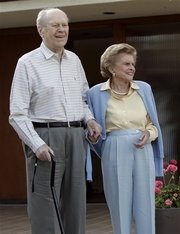
President Ford is discharged

I read today the President Ford is at home and resting after a brief stay at Vail Valley Medical Center, in Colorado, which is good news. I've always had a special admiration for him for how he led the country after Nixon's resignation.

At first, my heart leapt a little when I saw the headline that Ford, 93, had been released from the hospital. I had flashbacks to my Nan earlier this summer; when they released her, it was because there was nothing more they could do, and they sent her home where she wanted to spend her final days.

But, with Ford, it looks like it was a false alarm, and that's good. He's been in better health, but it looks as if he may become our oldest living president of all time on November 12 of this year, passing Ronald Reagan.

Ford is on my mind because I'm reading a very good book about his presidency, 31 Days. If I ever finish it, I will write a review of it and give you my thoughts. I've been working on it for months - I've just been so busy with other stuff, I'm waay behind on my book reading this year. But, I'll catch up at some point. My early thought on the book is that it's outstanding - I recommend it highly.

Labels: , , ,